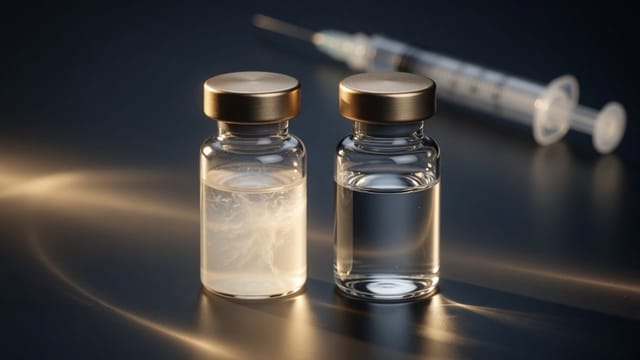
Proper peptide storage and reconstitution are critical for maintaining compound integrity and ensuring reliable research results. This guide covers best practices for handling lyophilized peptides from receipt through experimental use.
Storage of Lyophilized Peptides
Unreconstituted (Powder Form)
Lyophilized peptides are the most stable form and, when stored correctly, can maintain integrity for extended periods:
- Short-term (weeks): Store at 4°C (standard refrigerator), protected from light and moisture
- Long-term (months to years): Store at -20°C or -80°C in a manual-defrost freezer
- Critical: Keep peptides in their original sealed vial with the desiccant packet intact
- Avoid: Repeated freeze-thaw cycles of the dry powder (condensation introduces moisture)
Key Stability Factors
- Moisture — the primary degradation factor for lyophilized peptides. Always allow vials to reach room temperature before opening to prevent condensation
- Light — UV exposure can degrade sensitive amino acid residues (Trp, Tyr, Met). Store in amber vials or wrapped in foil
- Temperature — lower is better for long-term storage. -20°C is adequate for most peptides; -80°C for highly sensitive compounds
Reconstitution Protocol
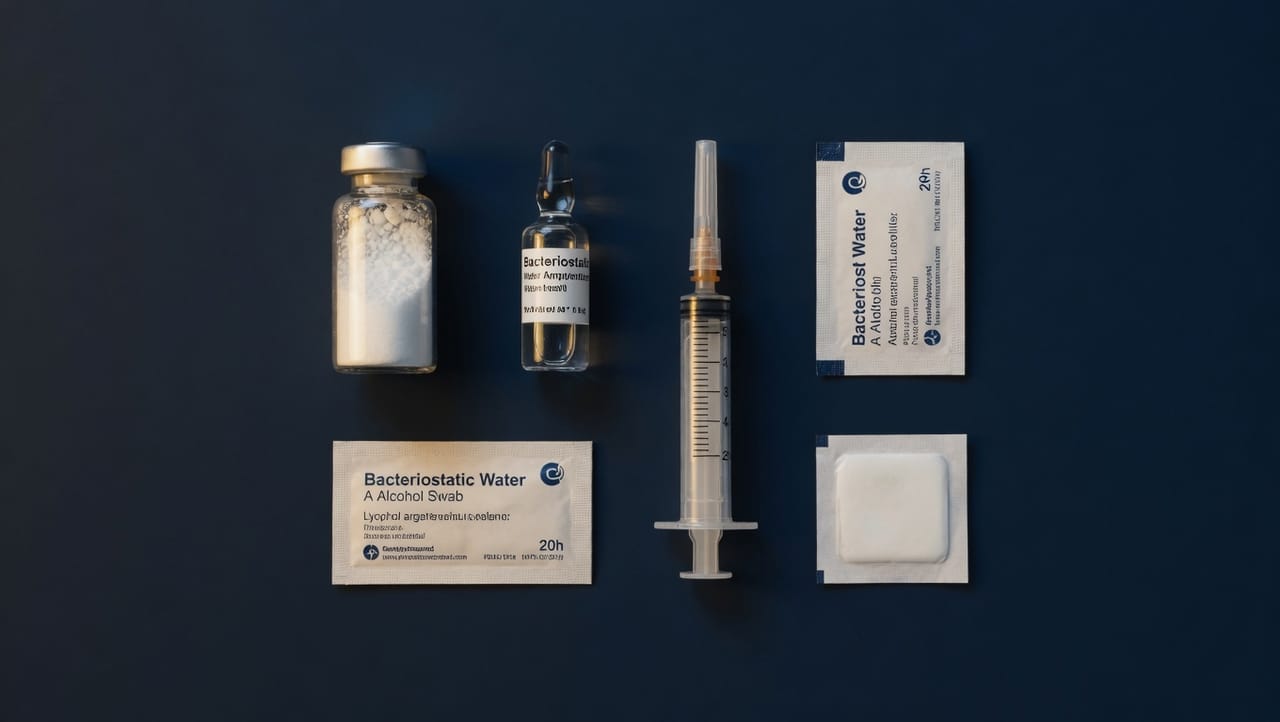
What You Need
- Lyophilized peptide vial
- Bacteriostatic water (0.9% benzyl alcohol) — preferred for multi-use reconstitution
- Sterile syringes (insulin syringes work well for small volumes)
- Alcohol swabs
Step-by-Step Reconstitution
-
Allow the peptide vial to reach room temperature (15-20 minutes). Opening a cold vial introduces condensation that degrades the peptide.
-
Wipe the rubber stopper with an alcohol swab and allow to dry.
-
Draw the desired volume of bacteriostatic water into a sterile syringe. The amount depends on your target concentration — see the concentration calculator section below.
-
Inject the water slowly against the glass wall of the vial, not directly onto the powder. This prevents foaming and denaturation.
-
Gently swirl the vial to dissolve. Never shake vigorously — shaking creates foam and can denature the peptide through mechanical stress.
-
Allow the solution to sit for 1-2 minutes if not fully dissolved. Most lyophilized peptides dissolve within seconds to minutes.
-
Inspect visually — the solution should be clear. Cloudiness may indicate aggregation or contamination.
Calculating Concentration
To achieve a desired concentration:
Volume (mL) = Peptide amount (mg) ÷ Desired concentration (mg/mL)
Example: 10mg BPC-157 at 2.5 mg/mL concentration:
- 10mg ÷ 2.5 mg/mL = 4 mL bacteriostatic water
Example: 5mg CJC-1295 at 1 mg/mL concentration:
- 5mg ÷ 1 mg/mL = 5 mL bacteriostatic water
Storage of Reconstituted Peptides
Once reconstituted, peptide solutions are less stable than their lyophilized form:
- Store at 4°C (refrigerator) — most reconstituted peptides remain stable for 3-4 weeks
- Bacteriostatic water extends usable life vs. sterile water because the benzyl alcohol inhibits microbial growth
- Never freeze reconstituted peptide solutions — ice crystal formation can damage the peptide structure and cause aggregation
- Protect from light — store in the original amber vial or wrap in foil
Stability Timeline
| Storage Condition | Estimated Stability |
|---|---|
| Lyophilized, -20°C | 12-24+ months |
| Lyophilized, 4°C | 3-6 months |
| Reconstituted, 4°C (BAC water) | 3-4 weeks |
| Reconstituted, 4°C (sterile water) | 1-2 weeks |
| Reconstituted, room temp | 24-48 hours |
Note: These are general guidelines. Actual stability varies by peptide sequence and formulation.
Common Mistakes to Avoid
- Injecting water directly onto powder — causes foaming and potential denaturation. Always aim for the glass wall.
- Shaking the vial — use gentle swirling motions only. Mechanical agitation denatures proteins and peptides.
- Using tap or distilled water — always use bacteriostatic water or sterile water for injection. Non-sterile water introduces microbial contamination.
- Repeated freeze-thaw of reconstituted solution — each cycle degrades the peptide. If you need long-term storage, aliquot into single-use vials before freezing.
- Storing at room temperature — reconstituted peptides degrade rapidly above 4°C.
Bacteriostatic Water vs. Sterile Water
| Property | Bacteriostatic Water | Sterile Water |
|---|---|---|
| Preservative | 0.9% benzyl alcohol | None |
| Multi-use | Yes (inhibits bacteria) | No (single use only) |
| Reconstituted stability | 3-4 weeks at 4°C | 1-2 weeks at 4°C |
| Recommended for | Multi-dose research vials | Single-use preparations |
For most research applications, bacteriostatic water is the preferred choice due to its antimicrobial properties and extended stability window.
Summary
Proper storage and reconstitution are foundational to reliable peptide research. Key principles: keep lyophilized peptides cold and dry, reconstitute gently with bacteriostatic water, store solutions at 4°C, and use within 3-4 weeks. Following these protocols ensures maximum peptide integrity throughout your research.
This guide is provided for educational purposes. All products are intended for laboratory and research use only.
Disclaimer: This article is provided for educational and informational purposes only. All products referenced are intended strictly for laboratory and research use.