Why AOD-9604 Turns Cloudy in Bacteriostatic Water
The benzyl alcohol in BAC water — not degradation — is usually the culprit.
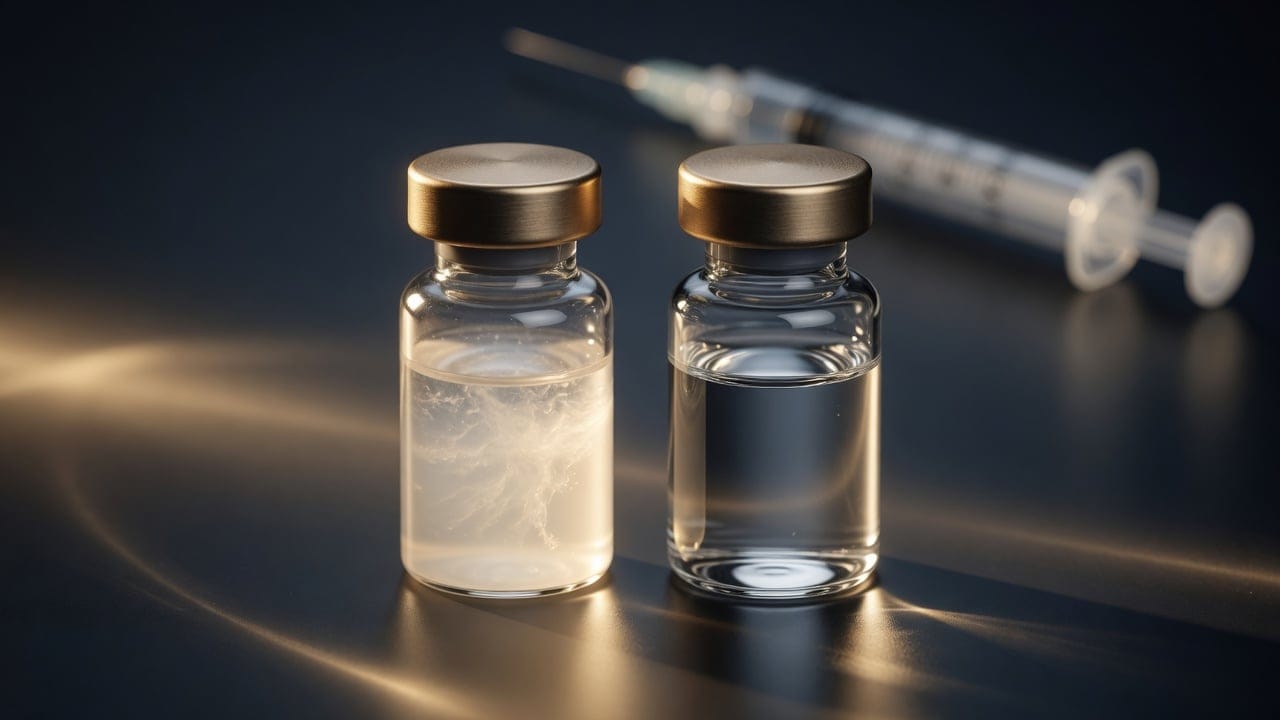
A frequent observation in the lab: you reconstitute AOD-9604 with bacteriostatic water, expecting the clear solution you get with most peptides, and instead the vial goes faintly milky or opalescent. Before assuming the compound is bad, it helps to understand what's actually happening. In the majority of cases, cloudiness in AOD-9604 is caused by the benzyl alcohol preservative in bacteriostatic water, not by degradation or contamination.
What AOD-9604 Is
AOD-9604 is a 16-amino-acid modified fragment of human growth hormone, corresponding to the C-terminal region (residues 177–191) with a tyrosine added at position 177. At roughly 1815 g/mol it is a relatively small, amphiphilic peptide — it carries both hydrophobic and hydrophilic character along its sequence. That amphiphilic nature is central to why it behaves differently from a simple, freely soluble peptide when it meets a preservative-containing solvent.
Why the Cloudiness Happens
Bacteriostatic water is sterile water with 0.9% benzyl alcohol added as an antimicrobial preservative. Benzyl alcohol is only sparingly water-soluble and is mildly hydrophobic. When it contacts an amphiphilic peptide like AOD-9604, a few things can occur:
- Micro-droplet / opalescence effect — benzyl alcohol that hasn't fully dispersed can form a fine dispersion, scattering light and giving the solution a milky appearance. This is a physical light-scattering phenomenon, not a chemical breakdown.
- Peptide–preservative interaction — the hydrophobic regions of the peptide can associate with benzyl alcohol, nudging the peptide toward transient aggregation or a colloidal state that reads as turbidity.
- Excipient interactions — trace salts or bulking agents from the lyophilization (e.g. acetate salt form, mannitol) can shift solubility at the working pH and contribute to haze.
Benign Cloudiness vs. a Real Problem
Not all cloudiness is equal. The distinction that matters is whether it clears and whether you can see discrete particles.
| Observation | Likely cause | Action |
|---|---|---|
| Faint haze/opalescence, no particles, clears on gentle swirl + warming to room temp | Benzyl alcohol dispersion | Benign — proceed |
| Milky but uniform, stable, no settling | Peptide–preservative colloid | Generally acceptable; switch to sterile water if clarity required |
| Visible floating particles or stringy material | Aggregation or incomplete dissolution | Investigate; likely discard |
| Cloudy with sediment that settles to the bottom | Precipitation / degradation / contamination | Discard |
| Cloudy + discoloration or odor | Contamination or breakdown | Discard |
The reliable tell is persistence and particulates. A uniform opalescence that clears when the vial warms up and is swirled points to the solvent. A solution with discrete particles, sediment, or that stays turbid regardless of temperature points to a genuine integrity problem.
Reconstituting for a Clear Solution
If your work requires an optically clear AOD-9604 solution — for spectrophotometric reads, or simply to remove ambiguity when inspecting the vial:
- Bring the vial to room temperature before opening (15–20 min). Cold glass causes condensation and exaggerates haze.
- Consider sterile water for injection instead of bacteriostatic water. With no benzyl alcohol present, AOD-9604 typically reconstitutes clear. The trade-off is a shorter usable window — sterile-water solutions lack antimicrobial protection and should be treated as single-use or short-term.
- Inject the solvent slowly against the glass wall, not directly onto the powder. This avoids foaming and localized over-concentration.
- Swirl gently; never shake. Mechanical shear promotes aggregation in amphiphilic peptides — exactly the state that reads as turbidity.
- Give it a minute. A haze that is going to clear usually does so within a minute or two at room temperature.
Bacteriostatic vs. Sterile Water for AOD-9604
| Property | Bacteriostatic Water | Sterile Water |
|---|---|---|
| Preservative | 0.9% benzyl alcohol | None |
| AOD-9604 appearance | Often cloudy / opalescent | Typically clear |
| Multi-use | Yes (inhibits bacteria) | No (single use) |
| Reconstituted stability | ~3–4 weeks at 4°C | ~1–2 weeks at 4°C |
| Best when | Multi-draw vials, longer window | Clarity or spectroscopy needed |
There is no single "correct" choice — bacteriostatic water is the right default for multi-use research vials and gives the longest stable window, while sterile water is the answer when clarity is non-negotiable. The cloudiness itself is not evidence that anything is wrong with the peptide.
When to Discard
Discard the vial if you see any of the following, since these indicate the peptide's integrity — not just its appearance — is compromised:
- Discrete particulates, fibers, or sediment that don't redissolve
- Turbidity that persists at room temperature and after gentle swirling
- Any discoloration (yellowing, browning) or off odor
- Cloudiness that appears days after a solution was initially clear (suggests aggregation or microbial growth)
When in doubt, the cost of a discarded vial is far lower than the cost of unreliable data from a degraded compound.
Summary
Cloudiness when AOD-9604 meets bacteriostatic water is, in most cases, a physical interaction with the benzyl alcohol preservative rather than a sign of a bad compound. A uniform opalescence that clears on warming and swirling is generally benign; discrete particles, sediment, discoloration, or persistent turbidity are not. If your protocol demands a clear solution, reconstitute with sterile water and accept the shorter stability window. Match the solvent to the experiment and inspect against the right criteria, and you'll avoid discarding good material — or trusting bad material.
This article is provided for educational purposes. All products are intended for laboratory and research use only and are not for human consumption.
Disclaimer: This article is provided for educational and informational purposes only. All products referenced are intended strictly for laboratory and research use.