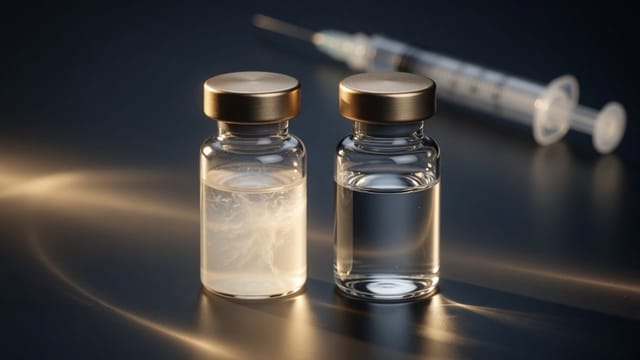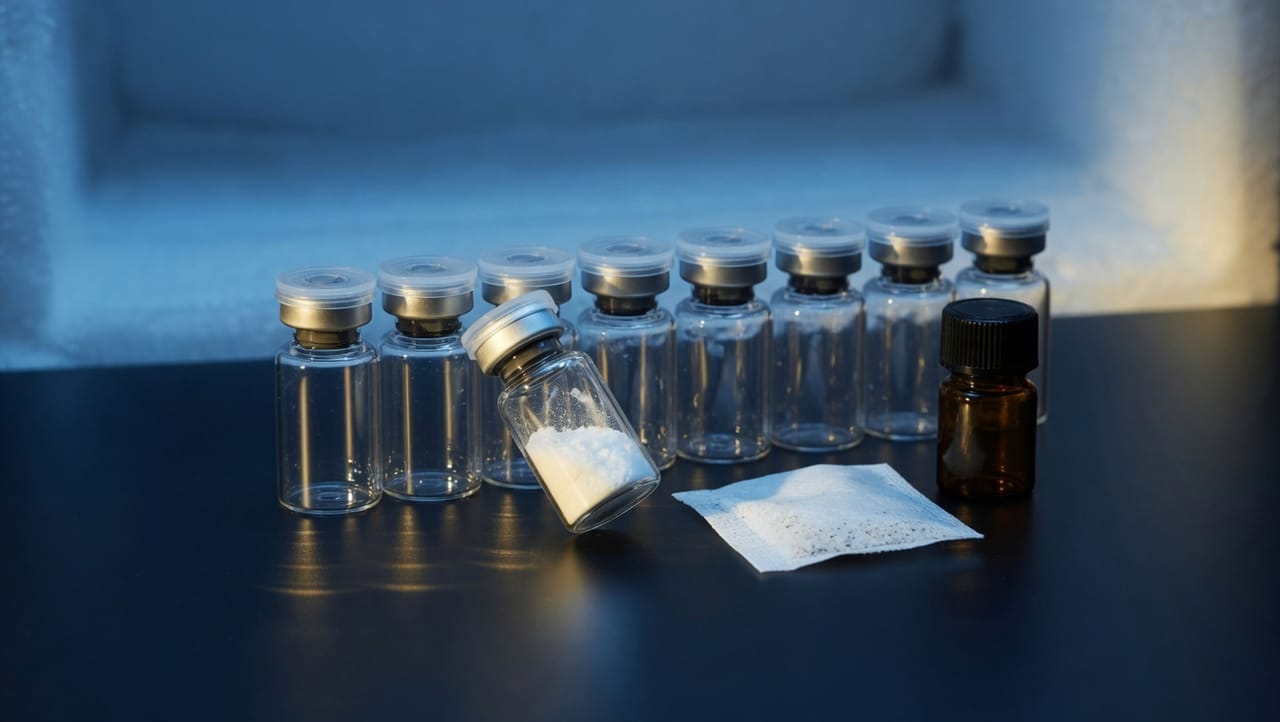
Peptides are inherently less stable than small-molecule compounds. Their biological activity depends on a precise three-dimensional structure maintained by non-covalent interactions — hydrogen bonds, hydrophobic contacts, and electrostatic forces — all of which are sensitive to environmental conditions. Understanding the degradation pathways that threaten peptide integrity is essential for designing storage protocols that preserve activity over time.
Chemical Degradation Pathways
Peptide degradation is driven by chemical reactions that modify the backbone or side chains, producing inactive or partially active variants. The major pathways are:
Deamidation
Asparagine (Asn) and, to a lesser extent, glutamine (Gln) residues undergo spontaneous deamidation — the hydrolysis of the side-chain amide group to form aspartic acid or glutamic acid. This introduces a negative charge at physiological pH and can alter peptide folding, receptor binding, and biological activity.
Deamidation is the most common chemical degradation pathway in peptides. Its rate depends on:
- Sequence context: Asn-Gly sequences deamidate fastest. Asn followed by small, flexible residues (Ser, Ala) also deamidate readily.
- pH: Deamidation accelerates above pH 6 and is particularly rapid at pH 7.4 (physiological).
- Temperature: The rate roughly doubles for every 10°C increase.
- Moisture: Lyophilized (freeze-dried) peptides deamidate much more slowly than those in solution.
Oxidation
Methionine, cysteine, tryptophan, and histidine are the most oxidation-prone residues:
- Methionine → Methionine sulfoxide (+16 Da): The most common oxidation event. Can proceed further to methionine sulfone (+32 Da) under harsh conditions.
- Cysteine → Cystine (disulfide bond): Free thiols oxidize to form inter- or intra-molecular disulfide bridges, potentially causing aggregation.
- Tryptophan → Various oxidation products: Including kynurenine and hydroxytryptophan, though these are less common at storage temperatures.
Oxidation is catalyzed by:
- Dissolved oxygen in solution
- Trace metals (Fe²⁺, Cu²⁺) acting as catalysts
- Light exposure (photosensitized oxidation)
- Peroxides in excipients or solvents
Hydrolysis
The peptide bond itself is susceptible to hydrolysis, particularly at Asp-Pro sequences, which cleave preferentially under acidic conditions. While the peptide bond is generally stable at neutral pH, extended storage in solution — especially at elevated temperatures — can lead to backbone cleavage.
Racemization
L-amino acids can convert to their D-enantiomers through base-catalyzed racemization. Aspartate and serine are the most susceptible. Racemization alters the local backbone geometry and can significantly reduce biological activity, as most receptors are stereospecific.
Pyroglutamate Formation
N-terminal glutamine or glutamic acid residues can cyclize to form pyroglutamate, releasing ammonia or water. This modification removes the free amino group, which may affect activity if the N-terminus is involved in receptor binding.
Physical Degradation
Beyond chemical modification, peptides can lose activity through physical degradation:
Aggregation
Peptides can self-associate through hydrophobic interactions, forming soluble oligomers or insoluble aggregates. Aggregation is accelerated by:
- High peptide concentration
- Elevated temperature
- Agitation (mechanical stress)
- Freeze-thaw cycles
Aggregated peptides may retain partial activity but exhibit altered pharmacokinetics and can produce inconsistent experimental results.
Adsorption
Peptides adsorb to surfaces — glass vials, plastic tubes, pipette tips, and filter membranes. Hydrophobic peptides are particularly prone to adsorption losses. At low concentrations (below 1 mg/mL), surface adsorption can account for a significant fraction of the total peptide, leading to underestimation of actual concentration.
Strategies to minimize adsorption:
- Use low-binding polypropylene tubes
- Pre-coat surfaces with carrier protein (BSA) if compatible with the assay
- Avoid repeated transfers between containers
- Prepare solutions at higher concentrations and dilute immediately before use
Environmental Factors
Temperature
Temperature is the single most important factor controlling peptide stability:
| Storage Condition | Typical Stability (Lyophilized) |
|---|---|
| -80°C | Years (indefinite for most peptides) |
| -20°C | 1–3 years |
| 2–8°C | Weeks to months |
| 25°C (room temperature) | Days to weeks |
| 37°C | Hours to days |
For reconstituted (in-solution) peptides, stability is dramatically shorter at every temperature. Most reconstituted peptides should be used within days when stored at 2–8°C, or aliquoted and frozen at -20°C for longer storage.
pH
Most peptides are most stable between pH 4 and pH 6. Deamidation accelerates above pH 6, while acid-catalyzed hydrolysis (particularly Asp-Pro cleavage) occurs below pH 3. Buffers with minimal metal-catalyzed oxidation potential — such as acetate (pH 4–5) or citrate (pH 3–6) — are preferred over phosphate buffers, which can promote aggregation.
Light
UV and visible light drive photodegradation, particularly of tryptophan, tyrosine, and phenylalanine residues. Photodegradation generates reactive oxygen species that initiate secondary oxidation cascades.
Store peptides in amber vials or wrapped in foil. Minimize exposure during handling — even brief fluorescent light exposure can measurably degrade sensitive sequences.
Moisture
Water is the primary driver of chemical degradation in lyophilized peptides. Even small amounts of absorbed moisture (below 5% w/w) can reactivate deamidation and hydrolysis pathways. Lyophilized peptides should be stored with desiccant in sealed containers, and vials should be equilibrated to room temperature before opening to prevent condensation.
Oxygen
Dissolved oxygen in solution and headspace oxygen in sealed vials both contribute to oxidation. For oxidation-sensitive peptides (those containing Met, Cys, or Trp):
- Purge vials with nitrogen or argon before sealing
- Use antioxidants (e.g., methionine as a sacrificial scavenger) if compatible
- Minimize headspace volume
- Avoid repeated opening of vials
Reconstituted Peptide Stability
Once a lyophilized peptide is reconstituted, the stability clock starts:
Recommended Solvents
- Bacteriostatic water (0.9% benzyl alcohol): Standard for most peptides. The preservative inhibits microbial growth but does not prevent chemical degradation.
- Sterile water: For single-use aliquots or when benzyl alcohol is incompatible.
- Dilute acetic acid (0.1%): For hydrophobic or aggregation-prone peptides that resist dissolution in water.
- DMSO: For highly hydrophobic sequences. Use as a co-solvent at low percentages (≤5%) and dilute into aqueous buffer.
Aliquoting Strategy
For peptides that will be used over multiple sessions:
- Reconstitute the full vial
- Immediately divide into single-use aliquots in low-binding tubes
- Flash-freeze in liquid nitrogen or dry ice
- Store at -20°C or -80°C
- Thaw one aliquot per use — never refreeze
This strategy eliminates repeated freeze-thaw cycles, which cause aggregation, adsorption losses, and concentration variability.
Monitoring Degradation
For long-term studies, periodic quality checks can verify that stored peptides remain within specification:
- HPLC: Compare chromatograms to the original COA. A new peak or shoulder indicates degradation.
- Mass spectrometry: +16 Da (oxidation) or -1 Da (deamidation) shifts are diagnostic.
- Bioassay: If a functional assay is available, compare activity to a freshly prepared reference standard.
Practical Summary
| Factor | Risk | Mitigation |
|---|---|---|
| Temperature | Accelerates all degradation | Store at -20°C or below |
| Moisture | Reactivates deamidation/hydrolysis | Desiccant, sealed vials, equilibrate before opening |
| Oxygen | Oxidation of Met/Cys/Trp | Nitrogen purge, minimize headspace |
| Light | Photodegradation | Amber vials, foil wrap |
| pH | Deamidation (>6), hydrolysis (<3) | Buffer at pH 4–6 when possible |
| Freeze-thaw | Aggregation, adsorption | Single-use aliquots |
| Surfaces | Adsorption losses | Low-binding tubes, higher concentrations |
Conclusion
Peptide stability is not a fixed property — it is a function of storage conditions, sequence composition, and formulation. A peptide that is stable for years as a lyophilized powder at -20°C may degrade within hours in neutral-pH solution at room temperature. By understanding the specific degradation pathways relevant to a given sequence and controlling the environmental factors that drive them, researchers can maintain peptide integrity from receipt through the final experiment.
A peptide that is stable for years as a lyophilized powder at -20°C may degrade within hours in neutral-pH solution at room temperature.
Disclaimer: This article is provided for educational and informational purposes only. All products referenced are intended strictly for laboratory and research use.