When a peptide supplier claims 99%+ purity, what does that number actually represent? Purity is the single most important quality metric for research peptides — it directly affects experimental reproducibility, dose accuracy, and the validity of downstream results. Understanding how purity is measured, what methods are used, and where impurities come from gives researchers the tools to evaluate suppliers and interpret Certificates of Analysis with confidence.
Why Purity Matters in Peptide Research
Impurities in a peptide sample are not inert. Deletion sequences, truncated fragments, oxidized variants, and residual solvents can all introduce confounding variables into an experiment. A peptide listed at 95% purity contains roughly 5% of unknown or partially characterized contaminants — enough to skew binding assays, alter dose-response curves, or produce off-target effects in cell-based studies.
For in-vitro research, purity above 98% is generally considered the minimum for reliable results. For quantitative studies — receptor binding, enzyme kinetics, structural biology — 99%+ purity is the standard.
High-Performance Liquid Chromatography (HPLC)
HPLC is the primary method for assessing peptide purity. It separates the components of a sample based on their interaction with a stationary phase (typically a C18 reverse-phase column) and a mobile phase gradient of water and acetonitrile with trifluoroacetic acid (TFA) as an ion-pairing agent.
How It Works
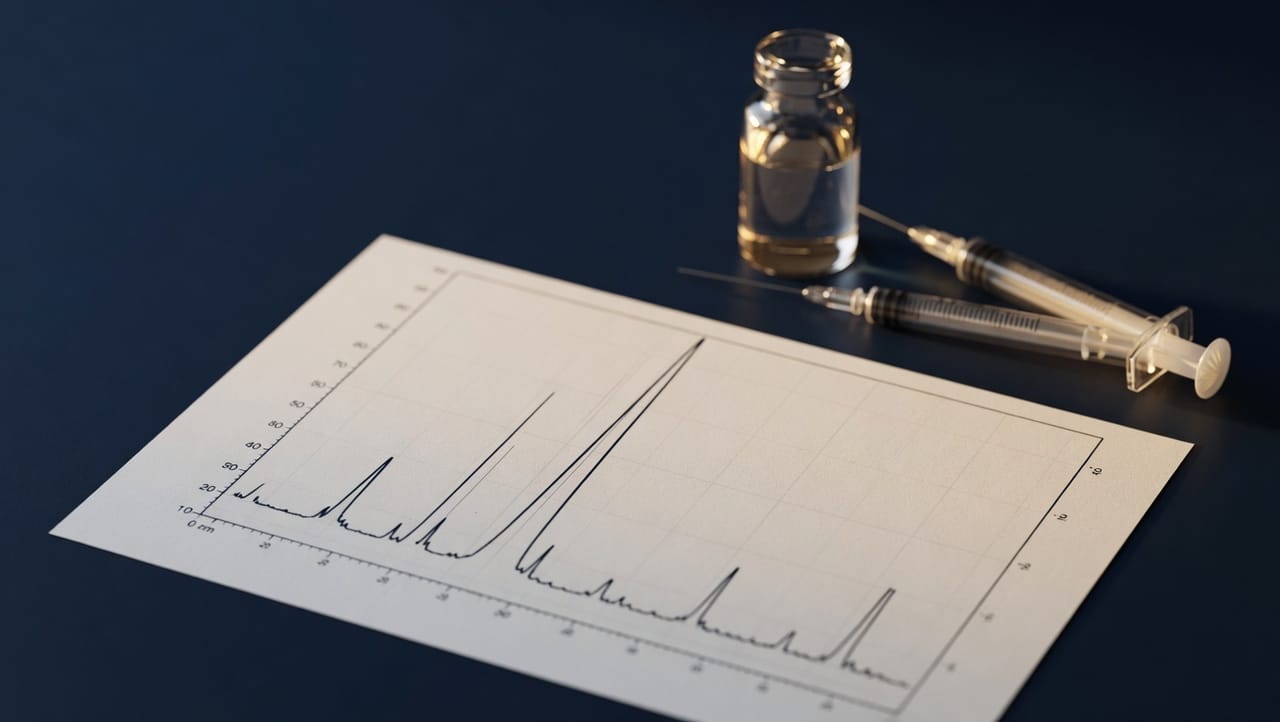
The peptide sample is dissolved and injected into the column. As the solvent gradient shifts from polar to nonpolar, different molecular species elute at different retention times. A UV detector (typically at 214 nm or 220 nm, where the peptide bond absorbs strongly) records the absorbance over time, producing a chromatogram.
Reading a Chromatogram
The target peptide appears as the dominant peak. Purity is calculated as:
Purity (%) = (Area of target peak / Total area of all peaks) × 100
A clean chromatogram shows a single sharp peak with a flat baseline. Minor satellite peaks represent impurities — deletion sequences, incomplete deprotection products, or aggregates.
Limitations
HPLC purity is a relative measurement. It assumes that all species absorb UV light proportionally and that the separation resolves all impurities. Co-eluting impurities (species with identical retention times) will inflate the apparent purity. This is why HPLC is typically paired with mass spectrometry for definitive identification.
Mass Spectrometry (MS)
Mass spectrometry confirms the molecular identity of the peptide by measuring its mass-to-charge ratio. The two most common ionization methods for peptides are:
- ESI (Electrospray Ionization): Generates multiply-charged ions, useful for peptides of all sizes. Produces a characteristic charge envelope that can be deconvoluted to determine the monoisotopic or average molecular weight.
- MALDI-TOF (Matrix-Assisted Laser Desorption/Ionization — Time of Flight): Produces primarily singly-charged ions, giving a straightforward mass spectrum. Particularly useful for larger peptides and proteins.
What MS Tells You
A mass spectrum confirms whether the synthesized peptide matches the expected molecular weight. A clean spectrum shows a dominant signal at the expected mass. Additional signals may indicate:
- Deletion peptides: Missing one or more amino acids (mass shifted by the residue weight)
- Oxidation products: +16 Da from methionine or tryptophan oxidation
- TFA adducts: +114 Da from trifluoroacetate salt retention
- Incomplete deprotection: Mass shifted by the protecting group weight (e.g., +100 for Boc)
MS Does Not Measure Purity
Mass spectrometry is an identification tool, not a quantitative purity method. It confirms what is present but not how much. A peptide can show a clean mass spectrum while still containing significant levels of co-eluting impurities that have similar masses. This is why HPLC and MS are complementary, not interchangeable.
Amino Acid Analysis (AAA)
Amino acid analysis quantifies the composition of a peptide by hydrolyzing it into individual amino acids and measuring their concentrations. It serves two purposes:
- Composition verification: Confirms that the correct amino acids are present in the expected ratios
- Content determination: Measures the net peptide content of the sample (accounting for water, salts, and counterions)
A vial labeled as containing 5 mg of peptide may contain only 3.5 mg of actual peptide, with the remainder being moisture, TFA salt, and acetate. AAA provides the true peptide content, which is critical for accurate molarity calculations in research.
Common Impurities in Synthetic Peptides
Deletion Sequences
During solid-phase peptide synthesis (SPPS), incomplete coupling at any step produces a truncated chain missing one or more residues. These deletion peptides are the most common impurity class and are typically the satellite peaks visible on HPLC.
Oxidation Products
Methionine, cysteine, and tryptophan residues are susceptible to oxidation during synthesis, cleavage, or storage. Methionine sulfoxide (+16 Da) is the most common oxidation product. Oxidized peptides may have altered biological activity.
Racemization
Certain amino acids (particularly histidine and cysteine) can undergo racemization during synthesis, converting the native L-configuration to the D-form. D-amino acid substitutions are difficult to detect by standard HPLC but can significantly affect peptide folding and receptor binding.
Residual Solvents and Salts
TFA from the cleavage and purification process can remain as a counterion. While generally present at low levels, TFA content matters for cell culture studies where it can affect pH and cell viability. Some suppliers offer acetate or hydrochloride salt exchange to minimize TFA content.
How to Read a Certificate of Analysis
A Certificate of Analysis (COA) should include, at minimum:
| Field | What to Look For |
|---|---|
| HPLC Purity | ≥98% for research grade, ≥99% for high-purity grade |
| Molecular Weight (MS) | Observed mass within ±1 Da of theoretical |
| Appearance | White to off-white lyophilized powder |
| Sequence | Confirmed by MS/MS or equivalent |
| Net Peptide Content | Actual peptide weight (may differ from gross weight) |
| Counterion | TFA, acetate, or HCl |
| Storage | Recommended conditions (typically -20°C, desiccated) |
A COA without HPLC chromatogram data or mass spectrum confirmation should be viewed with skepticism. Reputable suppliers provide raw analytical data alongside the summary table.
Third-Party Testing
Independent third-party testing by an accredited analytical laboratory provides the highest level of confidence. Third-party COAs eliminate the conflict of interest inherent in self-testing and can verify both purity and identity using standardized methods.
When evaluating a supplier, look for:
- HPLC chromatograms with clearly labeled axes and retention times
- Mass spectra showing the expected molecular ion
- Lot-specific COAs (not generic templates reused across batches)
- Willingness to provide raw analytical data upon request
Conclusion
Peptide purity is not a single number — it is a composite assessment derived from multiple orthogonal analytical methods. HPLC provides quantitative purity, mass spectrometry confirms identity, and amino acid analysis determines true peptide content. Together, they give researchers the information needed to trust their reagents and reproduce their results.
Purity is not a single number — it is a composite assessment derived from multiple orthogonal analytical methods.
Understanding these methods transforms a COA from an opaque document into a readable quality report — and makes the difference between choosing a supplier on trust versus choosing on evidence.
Disclaimer: This article is provided for educational and informational purposes only. All products referenced are intended strictly for laboratory and research use.